How to Collimate a Reflector Telescope with a Cap or Laser
A Newtonian reflector that needs collimation turns pinpoint stars into blurry blobs — and most beginners don't know how to fix it. Here is what the two main collimation tools do and which one to start with.
Newtonian reflector telescopes — including tabletop Dobsonians — rely on two mirrors working in precise alignment to focus starlight into a sharp image at the eyepiece. When those mirrors drift out of alignment (collimation), stars become elongated blobs, planetary detail softens, and the scope appears broken when it is simply misaligned.
Collimation is the process of re-aligning those mirrors. It sounds intimidating when a beginner hears it for the first time. In practice, a rough collimation check is a 2–5 minute process with the right tool. This guide explains what causes collimation drift, compares the two standard tools (collimation cap and laser collimator) on published design specifications and user-reviewed ease of use, and helps you decide which to start with.
This guide is based on manufacturer documentation, published tool specifications, and aggregated expert and beginner user reviews. We did not perform any collimation procedures or test any tools. Scope Atlas earns commissions as an Amazon affiliate when you purchase through our links — this does not change our spec-based verdicts.
Why Newtonian Reflectors Need Collimation
No spam. Unsubscribe anytime.
A Newtonian reflector's optical path:
- Incoming light hits the primary mirror (parabolic) at the bottom of the tube
- Reflected light travels up and hits the secondary mirror (flat, angled) near the top
- The secondary directs light out the focuser to the eyepiece
Both mirrors have adjustable mounting cells with set screws. Transport vibration, thermal expansion, and handling can shift these cells slightly. When misaligned, the focused image is off-center in the focal plane — which appears to the observer as blurry, comet-shaped, or asymmetric star images.
Scopes that need collimation: All Newtonian reflectors (including Dobsonians, Bird-Jones designs, and compact tabletop designs). Collimation is NOT required for refractors, or performed by the user on Schmidt-Cassegrains (which have a front-panel secondary adjustment but a different procedure).
Collimation Cap vs Laser Collimator: Comparison
| Feature | Collimation Cap | Laser Collimator |
|---|---|---|
| How it works | A cap with a center-drilled hole replaces the eyepiece; you look through the hole and center reflections by eye | A laser beam projects down the tube; you align mirror reflections by centering the return dot |
| Published accuracy | Sufficient for visual astronomy (dependent on user technique) | Higher precision per manufacturer claims; less dependent on user eye-centering |
| Ease for first-time users | Moderate — requires learning what "correct" looks like (concentric circles) | Easier to understand conceptually — "center the dot" |
| Speed once learned | 2–5 minutes | 2–3 minutes |
| Cost | Very low (typically the least expensive collimation tool available) | Moderate (more expensive than a cap, less than a quality eyepiece) |
| Works in daylight? | Yes | Yes |
| Works in dark? | Requires a light source | Yes — the laser is self-illuminating |
| Requires batteries? | No | Yes (typically AA or button cell) |
| Risk of misuse | Low | Low if instructions followed; never shine laser toward eyes |
| Appropriate user level | Absolute beginner | Beginner to intermediate |
The Collimation Cap: The Right First Tool
For a new beginner who has never collimated a telescope, the collimation cap is the recommended starting tool for one reason: it forces you to understand what you are looking at before you start adjusting. When you look through the center hole of a properly made cap into a Newtonian reflector, you see a series of nested circles (the primary mirror reflection, the secondary mirror, and your own eye's reflection). Proper collimation means those circles are concentric — centered on each other.
The cap gives you direct visual feedback on the mirror geometry rather than an indirect laser dot. Many experienced observers who own laser collimators still use a cap for a quick check before each session — it requires zero setup and no batteries.
Browse laser collimators and collimation accessories at /go/amazon-laser-collimator.
The Laser Collimator: Faster, More Precise, Better Later
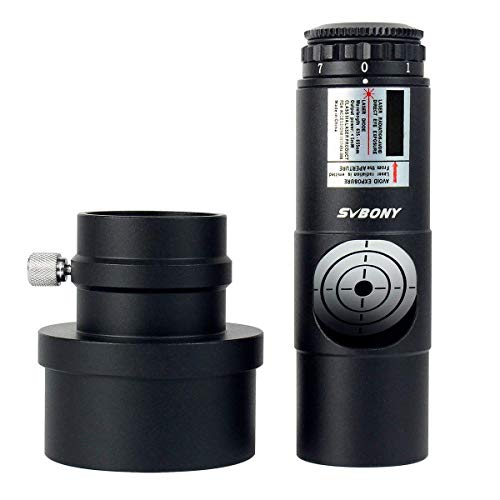
A laser collimator inserts into the focuser like an eyepiece, projects a beam down the tube onto the primary mirror, and produces a return beam. You adjust the secondary until the return dot lands on the center mark of the primary mirror, and adjust the primary until the return dot re-enters the collimator's input aperture.
Published advantages of quality laser collimators:
- Less subjective than eye-based cap judgment on near-collimation scopes
- Faster adjustment when you know roughly what you are doing
- Works in the dark — important for a quick re-check after setting up at a dark site
- Some designs include a Cheshire eyepiece combined with the laser for a two-stage check
The caution: A cheap laser collimator whose laser is itself misaligned introduces error rather than correcting it. Aggregated reviews consistently advise purchasing a collimator with a published collimation-check mechanism (a way to verify the laser is aligned to the barrel's axis). Well-reviewed brands publish this feature explicitly.
The Recommended Beginner Sequence
-
Start with a collimation cap. Learn what a collimated scope looks like by eye. Practice the adjustment sequence (secondary first, primary second — the published standard order) until you can achieve good collimation reliably.
-
Add a laser collimator once you understand the geometry. It makes the check faster and more consistent, and is particularly useful if you travel to dark sites and need a quick check on arrival.
-
Verify with a star test. After collimating with either tool, a defocused bright star is the ground-truth check. Concentric rings confirm good collimation. A laser or cap that was slightly off will show asymmetric rings — re-adjust.
What Collimation Does NOT Fix
- Poor atmospheric seeing (turbulent air) — no amount of collimation sharpens a view degraded by the atmosphere
- Optical quality limitations of the telescope itself
- Dirty or scratched mirrors — cleaning is a separate process with its own procedure and risks
Collimation is the first thing to check when a reflector's views disappoint. It is also one of the fastest fixes — and the skill to do it well is learned in a single session once you have the right tool in hand.
Step-by-Step: What You Are Trying to Achieve With Each Tool
Rather than a numbered procedure (which requires physically performing the steps to learn), here is what you are working toward with each tool.
Goal of collimation: Center the focused light cone on the eyepiece. Mechanically, this means:
- The secondary mirror is centered under the focuser (look down the focuser without an eyepiece to check)
- The secondary mirror is angled to reflect the primary mirror's reflection fully and centrally
- The primary mirror is tilted so its reflected image of the focuser and secondary is concentric
With a collimation cap: You see concentric reflections. A well-collimated scope shows — looking through the center-drilled hole of the cap — the primary mirror, the secondary mirror, and your own eye's reflection all nested concentrically like rings on a target. Any off-center nesting indicates the axis that needs adjustment.
With a laser collimator: The laser projects a dot onto the primary mirror's center spot (a small reflective marker many Newtonian primaries have). You adjust the secondary to center the dot on the primary's center spot, then adjust the primary until the laser dot returns precisely to the collimator's input aperture. The result is the same concentric alignment — verified by light beam rather than eye centering.
Common Beginner Collimation Mistakes
Aggregated reviews and forum discussions reveal consistent patterns in beginner collimation errors:
Over-adjusting: Making large adjustments to secondary or primary mirror cells when small corrections are needed. Collimation adjustments are small fractions of a turn on most collimation screws.
Adjusting in the wrong sequence: Standard procedure is secondary mirror first, then primary. Adjusting the primary before the secondary is centered wastes time — the secondary position determines where the primary's reflection needs to go.
Checking in daylight indoors: A star test is the definitive collimation check. A collimation cap or laser in daylight can get you close; the star test confirms whether you are there.
Using a misaligned laser collimator: A laser collimator that is itself out of alignment introduces error. Always verify the laser is centered in its barrel before using it as a reference — quality collimators include a rotation test for this purpose.
The Star Test: The Ground Truth
After collimating with a cap or laser, verify with a star test at medium-to-high magnification:
- Center a moderately bright star (not the brightest — it will saturate)
- Defocus slightly in both directions
- The defocused image should show concentric, symmetric rings
If the rings are centered and symmetric, collimation is correct. If they are off-center or asymmetric, one axis needs further adjustment. The star test reveals collimation errors that a cap or laser may miss — and no collimation procedure is complete without it.
A laser collimator that passes its own check can still show a slight star-test asymmetry if the laser's barrel fit is loose or if the focuser itself is slightly off-axis. For casual visual astronomy, small residual asymmetry is acceptable. For observing planetary detail at maximum magnification, the star test sets the standard.
Browse laser collimators and collimation accessories for Newtonian reflectors at /go/amazon-laser-collimator.
How Collimation Interacts With Seeing
A perfectly collimated telescope in poor atmospheric seeing will show worse planetary detail than a slightly miscollimated scope on an excellent seeing night. Collimation matters most when:
- Seeing is good (the atmosphere is not the limiting factor)
- Magnification is high (small errors amplify with magnification)
- The target is demanding (double stars, planetary surface detail)
For casual lunar sessions at 60–80×, slight miscollimation is often invisible. For planetary detail at 150×+, proper collimation is essential. Check collimation before any serious planetary session.
Affiliate Disclosure